Forward deployed engineers are having a moment, and AI automation is why

By Ashlyn D Rozario
Published · 6 min read
The short version
For years "forward deployed engineer" was a Palantir job title most developers had never heard of. In 2026 it's everywhere. Lightcast, which tracks job ads, counted fewer than 200 US postings for the role in 2023 and more than 7,300 in the first nine months of this year, according to CNBC. OpenAI, AWS and Anthropic have all put serious money behind teams of them.
The reason isn't hype about a job title. It's that AI automation has a last-mile problem, and forward deployed engineers are the people who walk that last mile.
What the job actually is
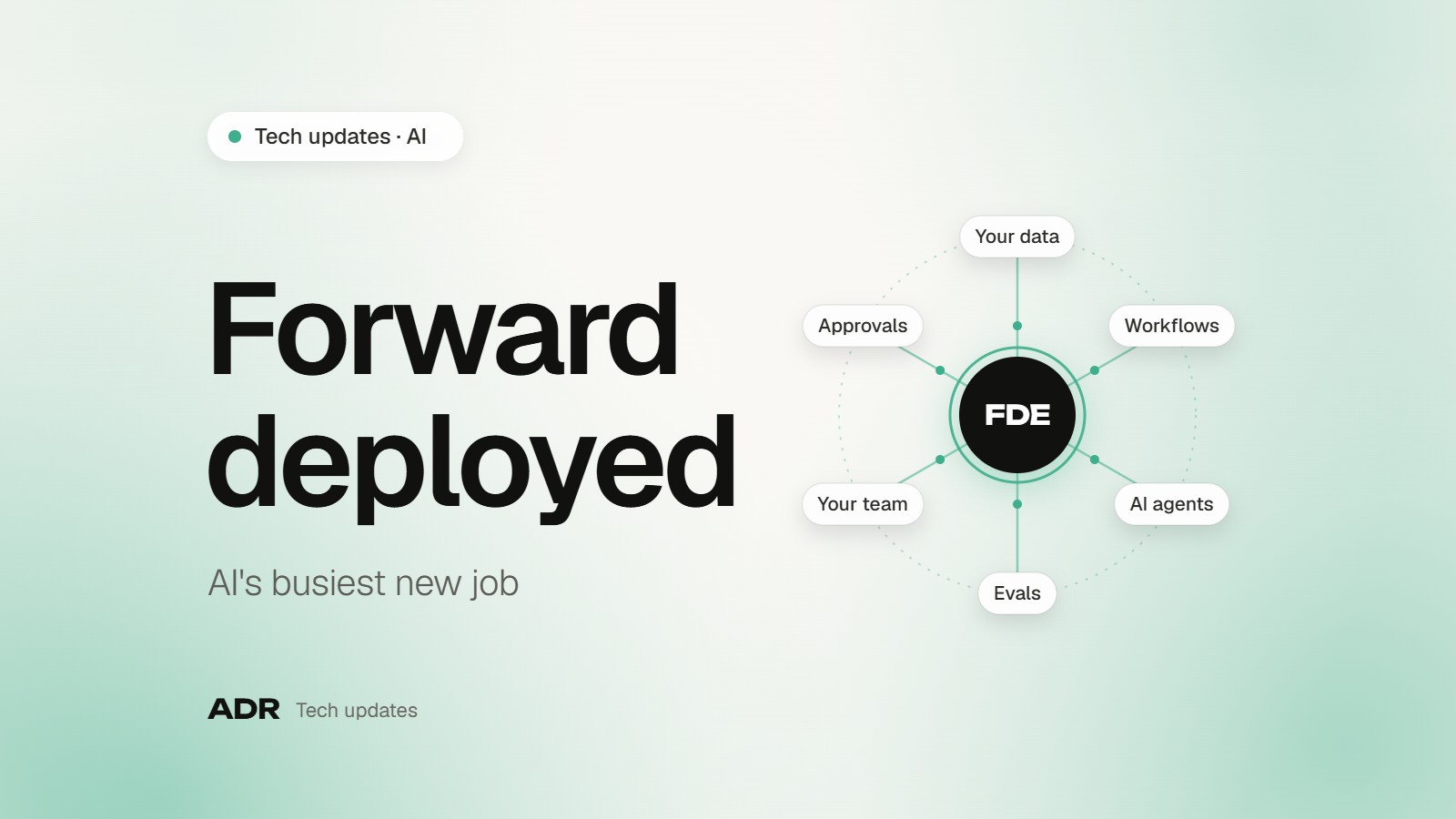
A forward deployed engineer (FDE) is a software engineer who works inside the customer's world rather than on a product roadmap. They sit with the people who'll use the system, find out how the work really happens, and build the integration, the data plumbing and the workflow that make the product useful there. Then they take what they learned back to the product team.
Palantir is where the role comes from. Its own blog explains that its engineers split into "Devs", who build the core product, and "Deltas", who are embedded with customers. The Delta name was a leftover from early business-development teams named after the NATO alphabet. For a long time that looked like an expensive Palantir quirk. Now it looks like a template.
Why AI automation made it matter
Here's the pattern I keep seeing. A company tries an AI agent, the demo is great, and then nothing ships. The model was never the hard part. The hard part is everything around it:
- The data lives in five systems, two of them older than the people using them.
- The workflow everyone describes isn't the workflow anyone follows.
- Somebody has to decide what the agent may do on its own and what needs a human to approve.
- Nobody can say whether it's working until someone defines "working" and measures it.
None of that can be solved from a product roadmap a thousand miles away. It takes an engineer who can read a messy database, sit in on a team's Tuesday meeting, build an evaluation set from real cases and write the glue code the same afternoon. That's the forward deployed engineer.
Agents raised the stakes. A chatbot that answers questions can get away with being bolted on. An agent that files claims, moves money or updates records has to be fitted to the business precisely, or it's a liability. So the more companies try to automate real work, the more they need people whose whole job is fitting.
The money behind it
This is where 2026 got interesting.
On 11 May, OpenAI launched the OpenAI Deployment Company, a separate business that's majority-owned by OpenAI. It's backed by more than $4 billion from a group of investment firms led by TPG. It also agreed to buy Tomoro, an AI consultancy, which brings roughly 150 engineers and deployment specialists on day one. The deal was still subject to regulatory approval when it was announced. The whole point of the unit is to put engineers inside client companies.
On 30 June, AWS committed $1 billion to a new unit of embedded AI engineers. CNBC reports it's starting with hundreds of engineers.
Anthropic works this way too. In May, the banking-software company FIS said Anthropic's forward deployed engineers were embedded with its team to co-design a financial crimes agent for banks. The agent gathers evidence from a bank's core systems and flags the riskiest anti-money-laundering cases for investigators. FIS said the engineers were also setting up evaluation frameworks and handing over know-how, so it could build more agents on its own.
Put together, the companies that make the models have concluded that selling the model isn't enough. Someone has to make it work on site, and they'd rather that someone be theirs.
How big is it really?
The numbers are big, and they're also messy, so it's worth being careful.
- Lightcast (via CNBC): fewer than 200 US postings in 2023, more than 7,300 in the first nine months of 2026.
- Lightcast (via Fortune): postings up more than 1,000% in January to August 2026 against the same months of 2025, with a median advertised salary above $188,000. Over the same stretch, the wider tech job market grew about 13%.
- Indeed (via Business Insider): 5,330 postings in April 2026, against 643 a year earlier.
- Indeed India: postings up nearly 19-fold between June 2025 and June 2026.
Two caveats. These are job ads, not hires. And the title is used loosely. One analysis found only around 1,000 to 1,400 jobs worldwide with the exact title, but 18,000 to 25,000 if you count similar customer-facing engineering roles under other names. Big consultancies are among the heaviest posters, which tells you some of this is old work wearing a new badge.
Consulting with a better title?
That's the sceptics' line, and it's fair to ask. A forward deployed engineer can drift into being a consultant who happens to write code, billing time to bend a product around one customer's quirks.
The difference, when it works, is the loop back. A consultant's work stays with the client. A good forward deployed engineer turns what they learned on site into product, so the next customer needs less custom work, and leaves the customer able to do more without them. The FIS arrangement, with its evaluation frameworks and knowledge transfer, is that idea written into a contract. If the loop isn't there, it really is just consulting, and the margins will show it.
What I take from it
This is close to how I've always liked to work. Most of the value in a build comes from understanding how a business actually runs before writing a line of code: who edits the site, where the leads go, what happens after someone clicks "Book". AI makes that understanding more valuable, not less, because an automation fitted to the wrong workflow just does the wrong thing faster.
If you're planning to put AI into your business, don't start with the model. Start with someone who'll sit with your team, map the real workflow, and build the narrow thing that removes one real chore, then measure it. Whether you call that person a forward deployed engineer or not doesn't matter much. Having one does.
Sources
- CNBC: AWS, Anthropic race to deploy army of specialized engineers key to proving AI spending will pay off (15 October 2026)
- The Next Web: OpenAI just acquired the consulting firm it was born alongside
- Yahoo Finance: OpenAI launches $4 billion AI deployment company
- The Star: Amazon's AWS commits $1 billion toward new unit for embedded AI engineers (30 June 2026)
- HR Executive: AWS joins OpenAI and Anthropic in race to embed engineers inside enterprises
- FIS: FIS brings agentic AI to banking with Anthropic, starting with financial crimes (May 2026)
- NewsBytes, on Fortune's Lightcast figures: Forward deployed engineers surge in Silicon Valley, pay above $188,000
- Georgia Southern University, citing Indeed's figures for Business Insider: What is a forward deployed engineer?
- BW Businessworld: Forward deployed engineer job postings surge 19-fold in a year
- Scaler: Forward deployed engineer jobs grew 1,165%. Here's what that number actually means
- KDnuggets: Forward deployed engineer: AI's hottest new career, or consulting with a better title?
- Palantir: Dev versus Delta: demystifying engineering roles at Palantir and Who wants to be a Delta?